
How a British Shorthair gets its distinctive color
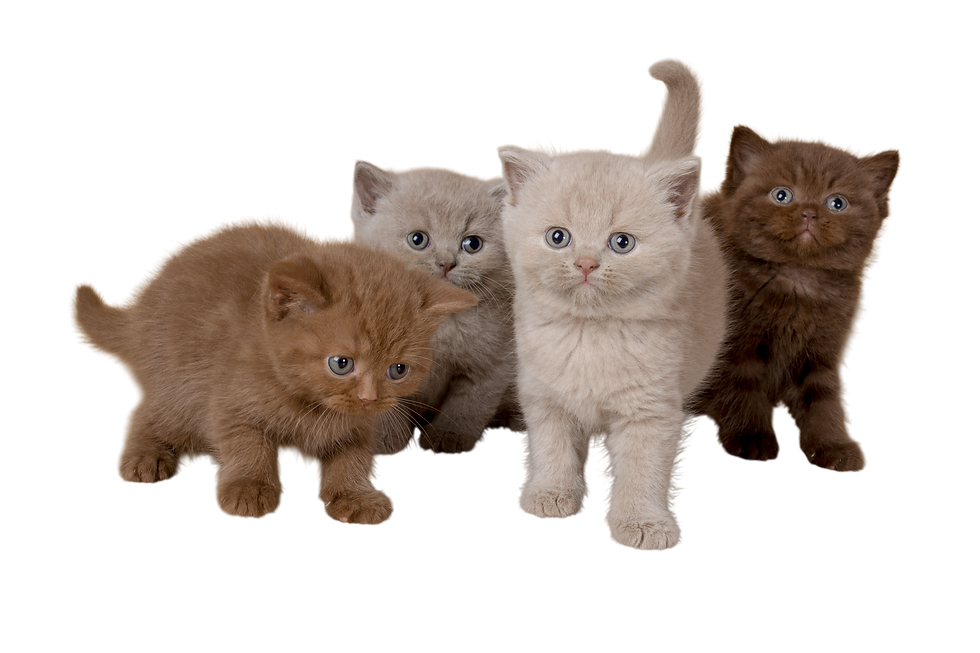
What makes a British Shorthair color so distinctive? When people picture a British Shorthair, they picture a gray cat with copper eyes. That gray has a name in the breed standard — blue — and it is the most recognizable coat in the breed. What almost no one asks is why it is gray. The answer is not that the cat makes gray pigment. It doesn't. A blue British Shorthair makes exactly the same black pigment as a black cat. What differs is how that pigment gets arranged inside the hair.
When people picture a British Shorthair, they picture a gray cat with copper eyes. That gray has a name in the breed standard — blue — and it is the most recognizable coat in the breed. What almost no one asks is why it is gray.
The answer is not that the cat makes gray pigment. It doesn't. A blue British Shorthair makes exactly the same black pigment as a black cat. What differs is how that pigment gets arranged inside the hair.
Two factors, not one
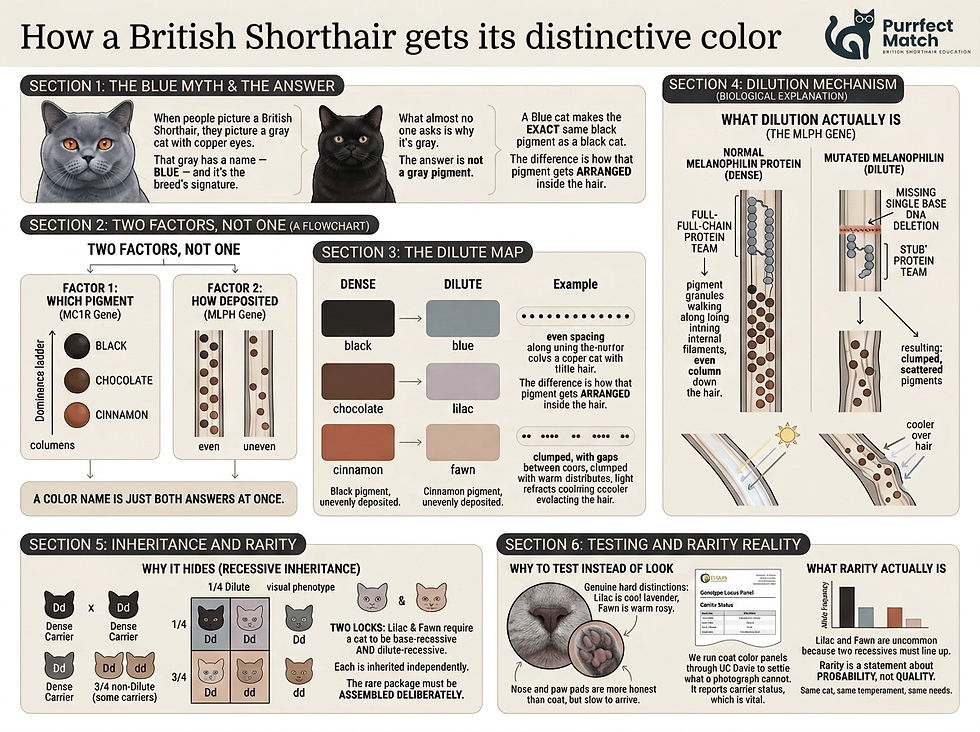
Every solid color in this breed is the answer to two separate genetic questions.
The first is which pigment. One gene decides whether a cat produces black pigment, chocolate pigment, or cinnamon pigment. These sit in a dominance ladder — black over chocolate over cinnamon — which means a black cat can quietly carry chocolate, and a chocolate cat can quietly carry cinnamon, with nothing visible to give it away.
The second is how it is laid down. A separate gene, on a different chromosome entirely, decides whether pigment is deposited evenly along the hair shaft or unevenly.
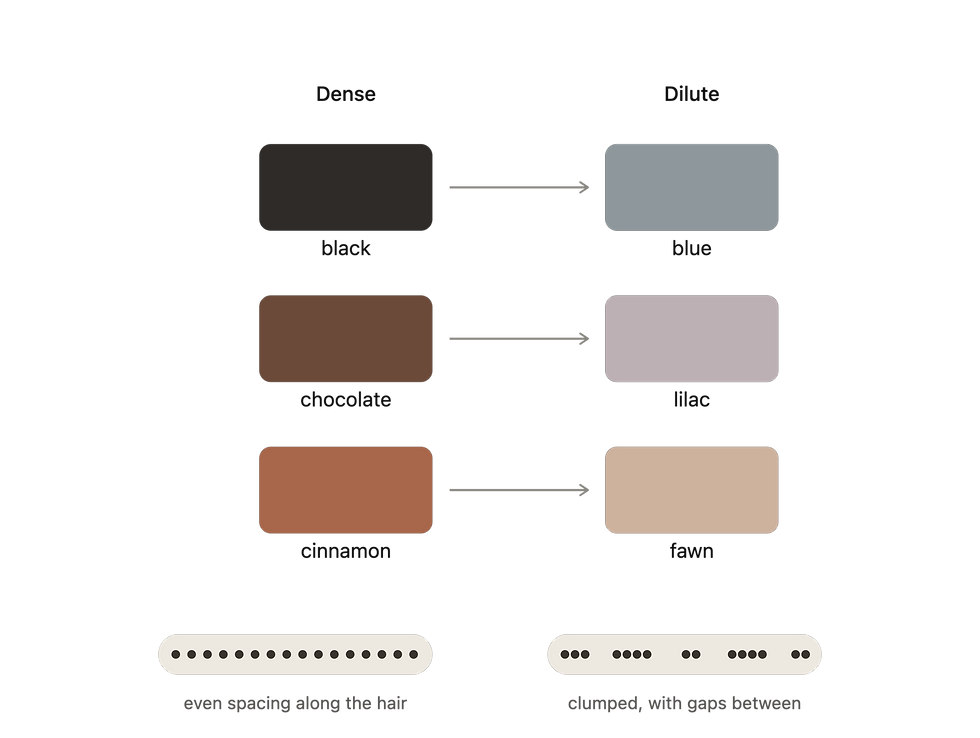
A color name is just both answers at once. Blue is black pigment, unevenly deposited. Lilac is chocolate pigment, unevenly deposited. Fawn is cinnamon pigment, unevenly deposited.
What dilution actually is
The dilute trait comes from a gene called MLPH, which builds a protein named melanophilin. Melanophilin's job is logistics. It works as part of a three-protein team that grabs pigment granules inside the cell and walks them outward along internal filaments, so they can be handed off and deposited in an even column down the growing hair.
The dilute version of that gene is missing a single base of DNA. One letter, deleted. That deletion shifts how the rest of the sequence is read and introduces a stop signal early, so the cell assembles only a stub of the protein instead of the whole thing. The transport system is left without a part it needs.
The effect shows up in the hair shaft. Instead of an even column, pigment granules clump and scatter, sitting in uneven bunches along the hair. The pigment itself is chemically unchanged — the same black, the same cinnamon. But light meeting a hair with clumped, gapped pigment returns paler and cooler than light meeting a hair packed evenly. The coat reads as a softened version of the color the cat was always going to be.
The difference is between a line drawn with a steady pen and the same ink applied in beads.
The dilute map
Dilution acts on every pigment a cat can make, which is why it touches the whole color chart rather than only the dark end:
Why it hides
Dilute is recessive, and that single fact explains most of how it behaves in a breeding program. A cat with two dense copies is dense and cannot pass dilution on. A cat with one of each is dense and carries it invisibly. Only a cat with two dilute copies shows it.
Two dense carriers bred together produce dilute kittens about a quarter of the time — and produce no visible evidence at all the other three quarters. In British Shorthairs, the dilute allele is common. Generations of selection for that blue coat have concentrated it until blue became the breed's signature rather than a novelty. So dilution by itself is not what makes a color rare here.
What is rare is dilution landing on top of the right base pigment.
Two locks
Lilac requires a cat to be chocolate-based and dilute. Fawn requires it to be cinnamon-based and dilute. Each condition is recessive on its own, and because the two genes sit on different chromosomes, they are inherited independently. Neither one pulls the other along.
Run the arithmetic on a pairing where both parents are black and carry cinnamon and dilute, hiding both. Each kitten has a one-in-four chance of landing cinnamon-based, and a separate one-in-four chance of landing dilute. Both at once is one in sixteen. The other fifteen come out looking like ordinary black or blue cats — some of them carrying the entire rare package invisibly, ready to hand it to a generation nobody planned. And that math assumes the cinnamon allele is in the pedigree to begin with. Usually it is not. Cinnamon entered the British Shorthair through a limited set of lines and remains uncommon in the gene pool. A breeder cannot stumble into fawn the way blue can happen by accident. It has to be assembled deliberately, over generations, by people tracking what their cats carry rather than what their cats look like.
One single mutation
A detail worth sitting with: when researchers sequenced dilute cats drawn from dozens of breeds and from random-bred populations, they found the same single deletion in every one of them, carried on the same shared stretch of chromosome. Not many similar mutations that happened to look alike. One mutation, one time, somewhere far back in the history of the domestic cat, inherited ever since.
The blue British Shorthair asleep on a sofa in Illinois, the Chartreux, the Russian Blue, the gray cat behind the gas station — all of them are descended from that one event.
Why to test instead of look
Lilac and fawn are the two colors most often misidentified, including on paperwork from breeders who do not test. Both are pale. Both are subtle. They separate on a distinction that is genuinely hard to hold in the eye: lilac carries a cool lavender cast, fawn a warmer rosy one, and ordinary indoor lighting will lie about either. Nose leather and paw pads are more honest than the coat, but a newborn's pigment is not fully deposited for weeks after birth, so the most reliable evidence is also the slowest to arrive.
So we do not guess. We run coat color panels through the UC Davis Veterinary Genetics Laboratory, which reports the genotype at each locus directly. A panel settles what a photograph cannot, and it does a second job at the same time: it reports carrier status, so we know what a cat can produce as well as what it is.
A footnote on caramel
Now and then a dilute cat shows a brassier, warmer cast than blue, lilac, or fawn should carry. It is usually described as caramel, or apricot in the cream series, and attributed to a separate modifier that acts only on cats that are already dilute. There is no validated DNA test for it. Any caramel claim therefore rests on visual judgment rather than on a result, which is worth knowing if you are ever offered one. We mention it because the question comes up, not because we can answer it with a panel.
What rarity actually is (and what it isn't)
Rarity in this breed is arithmetic. Lilac and fawn are uncommon because two recessive systems have to line up in the same kitten, and one of those systems is scarce in the breed to begin with. That is a statement about probability, not about quality.
A fawn kitten and a blue kitten from the same health-tested parents are the same cat in every way that will matter across the next fifteen years — same build, same coat texture, same steady temperament, same needs. The genetics are worth understanding for a narrower reason: they tell you what to ask a breeder, and whether the answer you get back is a result or a look.
🐾 Curious about an upcoming litter? → see current litters or learn about the reservation process
🐾 To stay updated on new arrivals and available litters, subscribe to our newsletter

Comments