
Why a cat on your lap is good for you: the science behind your health & feline companionship


There is a reason people describe a purring cat as calming rather than merely pleasant. The sound is low enough to feel through your hands and chest, it arrives only when the cat has decided you are safe, and a growing body of research suggests that what happens to you in those minutes is measurable. This post looks at what the purr is, what it may do for the cat, and what time with a cat does for the people who live with one.
What a purr actually is
A cat’s purr sits between roughly 25 and 150 hertz, with most domestic cats purring at a fundamental frequency near the bottom of that range. Cats purr during both inhalation and exhalation with a consistent pattern and frequency between 25 and 150 Hertz. That is far below the lowest note a human voice can produce, which is why you feel a purr as a vibration as much as you hear it as a sound.
For decades the accepted explanation was that purring required constant signaling from the brain to the muscles of the larynx, twitching them open and shut dozens of times a second. A 2023 study in Current Biology complicated that picture. Researchers at the University of Vienna found that without any muscle contractions or neural input, all eight larynges produced a purring sound through self-sustained vocal fold oscillations at frequencies within the range of domestic cat purring, between 25 and 30 Hz. The key appears to be small pads of connective tissue embedded in the vocal folds, which make them denser and slow their vibration. The mechanism resembles the “vocal fry” register in human speech. Once a cat starts purring, in other words, the body may carry it along with very little effort, which helps explain how a cat can purr for an hour without tiring.
What the purr may do for the cat
Cats purr when content, but they also purr when injured, in labor, and near death, which has long puzzled researchers. A bioacoustician named Elizabeth von Muggenthaler proposed in 2001 that the purr’s frequency range is not an accident: domestic cat purring falls within a frequency range of 25 to 150 Hz, with most individual cats purring at a fundamental frequency between 25 and 50 Hz, and low-frequency vibration in that range is used in some human therapeutic contexts for bone and tissue. Her suggestion was that purring might serve the cat as a low-cost way of maintaining its own body.
What a cat does for you
The better-documented effects are on the person. A randomized trial at Washington State University assigned 249 students to one of four conditions, and students in the hands-on condition had lower posttest cortisol compared to slideshow, waitlist, and observation groups. Ten minutes of petting cats and dogs lowered the stress hormone in a way that watching other people pet them, or looking at pictures of them, did not. The contact itself mattered.
Hormone studies point the same direction. Researchers in Japan, for example, reported in 2021 that brief petting sessions with their cats boosted oxytocin levels in many owners. A 2025 study added a detail that will not surprise anyone who lives with a cat: the oxytocin response in both owner and cat was strongest when the contact was initiated or accepted by the cat, and weaker or absent when it was forced. The calm a cat offers is conditional on the cat’s consent, which may be part of why it feels earned.
The most striking finding is also the one to hold most loosely. A University of Minnesota analysis of about 4,400 adults followed for 20 years found that after adjustment for differences in age, gender, ethnicity/race, systolic blood pressure, cigarette smoking, diabetes mellitus, serum cholesterol, and body mass index, a significantly lower RR for death due to MI was observed in participants with past cat ownership, with cat owners roughly a third less likely to die of a heart attack over the period. The lead author was careful to say the study could not establish cause, and that people who choose cats may differ from people who do not in ways that protect the heart independently. It is an association, not a prescription. But it is a large one, from a national dataset, and it has held up as a reference point for nearly two decades.
The social side
There is also evidence that cats have learned to speak to us specifically. A 2009 study from the University of Sussex found that when cats purr to ask for something, they embed a higher-pitched element inside the low rumble, one that at a frequency of around 380 Hz (middle G or thereabouts), this extra sound stood out from the typical low frequencies of a purr, and is more like a cry or a meow. Listeners rated these purrs as more urgent even when they had never owned a cat, and when researchers digitally removed the embedded cry, the urgency vanished. The lead author suggested cats learn to exaggerate this element because it works on people in a way that plain meowing, which tends to get a cat removed from the bedroom, does not. The purr, it turns out, is partly a language cats developed for living with us.
Why this matters for a British Shorthair
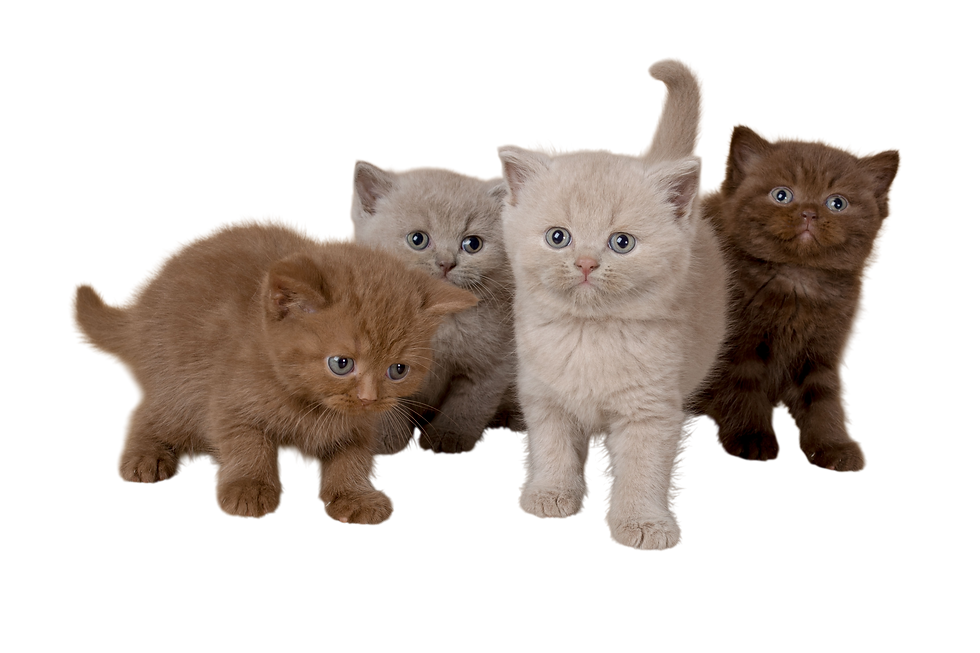
Every breed purrs, but temperament shapes how much of this a household actually receives. British Shorthairs are an observational breed: they tend to arrive at contact on their own schedule, settle near you rather than on you at first, and extend lap time as trust accumulates. That pace maps onto what the oxytocin research describes, where the response is strongest when the cat chooses the interaction. A British Shorthair that has decided you are its person is a reliable, unhurried source of exactly the kind of contact the studies measured.
They are also, as a breed, generous with the sound itself. Smokey, a tortoiseshell British Shorthair in England, held the Guinness World Record for the loudest purr from 2011 to 2014, measured at 67.7 decibels, about the volume of ordinary conversation. Most will not reach that, but the dense body and broad chest of the breed give the purr a resonance you feel through a lap.
This helps to explain what happens when a cat settles against you: the breath slows, the shoulders drop, and something in the body registers that it is, for the moment, safe.
🐾 Curious about an upcoming litter? → see current litters or learn about the reservation process
🐾 To stay updated on new arrivals and available litters, subscribe to our newsletter


Comments